


Biography
Erna Nook Jackson (November 30, 1886 – active until at least 1958) was a Canadian painter celebrated for the quiet beauty and lyrical sensitivity of her rural and coastal landscapes as well as her intimate still-life subjects. Born in Petrolia, Ontario, Jackson worked primarily in oil, developing a distinctive style marked by poised compositions, refined colour relationships, and an ability to evoke a deep sense of place and memory.
Jackson built her artistic foundation through studies with respected Canadian painters. By 1925 she had trained at the Central Technical School in Toronto and taken summer instruction with Farquhar MacGillivray Knowles, whose atmospheric approach left a clear influence on her early landscapes. By 1935 she expanded her studies under J. W. Beatty at Port Hope, absorbing his confident treatment of the Canadian environment. By 1945 she had further refined her craft at the Ontario College of Art, strengthening both her technique and artistic range.
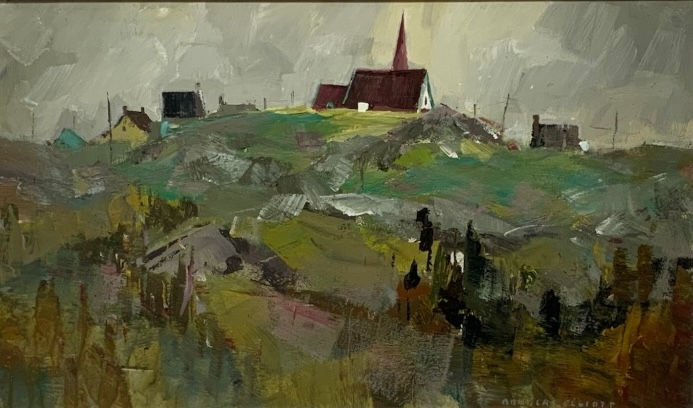
Throughout her career she painted across Ontario, Québec, and British Columbia. Her most recognizable works draw from these regions — particularly the Huntsville forests and the rolling scenery of the Dundas Valley — capturing their seasonal shifts with clarity and a gentle sense of nostalgia. She maintained a notable exhibition record, showing with the Art Association of Montreal between 1928 and 1936 and appearing in Royal Canadian Academy of Arts exhibition records in 1936, 1942, and 1944.
A significant late development in her work was documented in a 1958 Hamilton Spectator review, which described a well-received exhibition in Dundas. After returning from a trip to the West Indies, Jackson introduced a vibrant new direction in her art — smaller, colourful works filled with market scenes, local figures, and expressive everyday life. The critic noted that this shift revealed a “new world both around her and within her,” bringing greater originality, intensity, and imagination to her practice. This exhibition confirmed that Jackson remained an active, evolving artist well into the late 1950s.
top of page
You Might Also Like


bottom of page